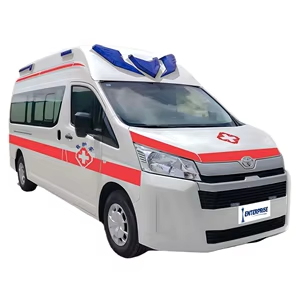
Toyota Hiace Extended Roof Ambulance By Infinity Chassis Engineering Team – ISO 9001:2015 & EN1789 Certified Ambulance Manufacturer
Introduction
When it comes to ambulance conversions, interior height is one of the most critical factors determining clinical capability. The Toyota Hiace extended roof ambulance (also known as super high roof) represents the maximum interior space available on the Hiace platform – allowing medical staff to stand fully upright and perform advanced life support procedures without restriction.
While standard and high roof Hiace ambulances serve many purposes, the extended roof configuration is specifically designed for ALS (Advanced Life Support) and ICU (Intensive Care Unit) operations where every centimeter of working space matters.
This comprehensive guide covers everything you need to know about the Toyota extended roof ambulance: dimensions, benefits, medical configurations, and how it compares to standard and high roof options.
📌 Related: Toyota Hiace Ambulance Complete Guide | Hiace High Roof vs Standard Roof | Hiace Interior Design
What is an Extended Roof Ambulance?
An extended roof ambulance (also called super high roof) features a taller patient compartment than standard or high roof configurations. On the Toyota Hiace platform, this means:
| Roof Type | Interior Height | Standing Access | Medical Capability |
|---|---|---|---|
| Standard Roof | ~1,350 mm (53″) | No – crouching required | BLS only |
| High Roof | ~1,900 mm (75″) | Yes – full standing | BLS, ILS, ALS |
| Extended / Super High Roof | ~2,100 mm (82″) | Yes – extra headroom | ALS, ICU, Critical Care |
Key distinction: The extended roof provides an additional 200 mm (8 inches) of headroom compared to the high roof – enough to accommodate taller medical staff, ceiling-mounted equipment, and improved airflow.
⚠️ Important Note: The extended/super high roof option is available on the H300 series (2019-present). The H200 series (2004-2019) does not offer an extended roof – only standard and high roof options are available.
Toyota Hiace Extended Roof Availability by Model
| Model | Standard Roof | High Roof | Extended / Super High Roof |
|---|---|---|---|
| H200 Series (2004-2019) | ✓ | ✓ | ✗ |
| H300 Series (2019-present) | ✓ | ✓ | ✓ |
For extended roof ambulance conversion, you must use the H300 series chassis.
Toyota Extended Roof Ambulance Interior Dimensions
| Measurement | Standard Roof | High Roof | Extended / Super High Roof |
|---|---|---|---|
| Interior height | 1,350 mm (53″) | 1,900 mm (75″) | 2,100 mm (82″) |
| Interior width | 1,650 mm (65″) | 1,650 mm (65″) | 1,650 mm (65″) |
| Interior length (patient area) | 2,800-3,100 mm | 2,800-3,100 mm | 2,900-3,200 mm |
| Standing access | No | Yes | Yes (extra clearance) |
| Suitable for tall staff (185cm+) | No | Limited | Yes |
Why Extra 200mm Matters
The additional 200 mm (8 inches) of headroom in the extended roof provides:
| Benefit | Explanation |
|---|---|
| Tall staff accommodation | Paramedics up to 195 cm (6’5″) can work comfortably |
| Ceiling-mounted equipment | Room for ceiling-mounted monitors, IV tracks, and lighting |
| Improved airflow | Better ventilation and infection control |
| Reduced claustrophobia | More comfortable environment for conscious patients |
| Air ambulance interface | Easier transfer from helicopter stretchers |
Toyota Extended Roof Ambulance Technical Specifications
| Specification | Value |
|---|---|
| Base chassis | Toyota Hiace H300 (2019-present) |
| Roof type | Factory super high roof or professional extended conversion |
| Exterior height (approx.) | 2,500 – 2,700 mm (depending on equipment) |
| Interior standing height | 2,100 mm (82 inches / 6.9 feet) |
| Patient compartment volume | Approximately 30-40% larger than high roof |
| Garage clearance required | Minimum 2,700 mm (9 feet) |
| Suitable for | ALS, ICU, long-distance critical care transport |
Extended Roof vs High Roof: Detailed Comparison
| Feature | High Roof (1,900 mm) | Extended Roof (2,100 mm) |
|---|---|---|
| Standing height | Suitable for staff up to 185 cm | Suitable for staff up to 195 cm |
| Ceiling equipment | Limited space | Ample space for ceiling-mounted systems |
| Airflow | Good | Excellent |
| Patient comfort | Good | Superior |
| Fuel efficiency | Good | Slightly reduced |
| Garage compatibility | Requires high clearance | Requires very high clearance |
| Wind resistance | Moderate | Slightly higher |
| Vehicle stability | Good | Moderate (higher center of gravity) |
| Best for | Urban EMS, general ALS | ICU, critical care, tall staff |
Medical Configurations for Extended Roof Ambulance
ALS (Advanced Life Support)
The extended roof is ideal for full ALS configuration:
| Equipment | Placement Advantage |
|---|---|
| Defibrillator/monitor | Wall-mounted at eye level |
| Transport ventilator | Ceiling-mounted or shelf-mounted |
| Infusion pumps (2-4) | Pole-mounted with full vertical adjustment |
| Suction unit | Wall-mounted at comfortable height |
| Oxygen flowmeter | Wall-mounted at head position |
| IV hooks | Ceiling track system |
ICU / Critical Care Transport
For ICU-level care, the extended roof is essential:
| Equipment | Extended Roof Benefit |
|---|---|
| Neonatal incubator | Fits with ceiling-mounted monitoring |
| Multiple infusion pumps | Stackable without headroom issues |
| Ventilator with humidifier | Full vertical clearance |
| Patient warming system | Ceiling-mounted radiant warmer option |
| Telemedicine equipment | Camera and screen at optimal height |
Multi-Patient Configuration
The extended roof also enables:
| Configuration | Capacity |
|---|---|
| Two stretchers (tandem) | 2 patients + 2 attendants |
| Stretcher + family seating | 1 patient + 3 family members + 2 staff |
| Stretcher + incubator | 2 critical patients simultaneously |
Who Needs an Extended Roof Ambulance?
| Organization Type | Why Extended Roof? |
|---|---|
| ICU transport teams | Need space for ventilators, monitors, multiple pumps |
| Neonatal transport | Incubators require vertical clearance |
| Teaching hospitals | Students need room to observe procedures |
| Long-distance critical care | Comfort during extended transport |
| Bariatric patient transport | Extra room for specialized equipment |
| Air ambulance backup | Compatibility with helicopter stretchers |
| Military MEDEVAC | Space for tactical equipment and personnel |
Toyota Hiace Extended Roof Ambulance vs Competitors
| Feature | Hiace Extended Roof | Mercedes Sprinter H3 | Ford Transit H3 |
|---|---|---|---|
| Interior height | 2,100 mm | 2,100 mm | 2,000 mm |
| Interior width | 1,650 mm | 1,780 mm | 1,750 mm |
| Standing access | Yes | Yes | Yes |
| Fuel efficiency | Best | Moderate | Good |
| Maneuverability | Best | Moderate | Good |
| 4WD availability | Limited markets | Yes (factory) | Limited |
| Global parts | Excellent | Excellent | Good |
| Cost | Lowest | Highest | Moderate |
Important Considerations for Extended Roof Ambulance
Garage and Parking Requirements
| Consideration | Detail |
|---|---|
| Minimum door height | 2,700 mm (9 feet) |
| Standard garage compatibility | Unlikely – requires modified facilities |
| Parking garage restrictions | Check local height limits |
| Home garage parking | Not possible in standard garages |
Vehicle Dynamics
| Consideration | Impact |
|---|---|
| Center of gravity | Higher than standard roof |
| Crosswind sensitivity | Increased |
| Cornering stability | Moderate reduction |
| Recommended speed | Reduce in high winds |
| Suspension upgrade | Recommended for stability |
Climate Control
| Consideration | Requirement |
|---|---|
| HVAC capacity | Higher than standard roof (larger volume) |
| Heating time | Longer to reach temperature |
| Cooling time | Longer in hot climates |
| Recommended | High-capacity AC and diesel heater |
Extended Roof Conversion Process
For H300 models without factory super high roof, professional extended roof conversion is available:
| Step | Process |
|---|---|
| 1 | Remove original roof section |
| 2 | Install raised roof structure (fiberglass or aluminum) |
| 3 | Add thermal and acoustic insulation |
| 4 | Install extended interior ceiling panels |
| 5 | Upgrade HVAC for larger volume |
| 6 | Test for leaks and structural integrity |
| 7 | Recertify EN1789 compliance |
⚠️ Always use certified conversion specialists like Infinity Chassis Units for extended roof conversion to ensure safety and regulatory compliance.
Toyota Extended Roof Ambulance Price Factors
Note: Prices vary by configuration. Contact us for a firm quote.
| Factor | Impact on Price |
|---|---|
| Base chassis (H300) | Higher than H200 |
| Extended roof conversion | +5,000–10,000 |
| Medical equipment level (BLS vs ALS vs ICU) | +10,000–30,000 |
| EN1789 certification | +3,000–6,000 |
| Climate adaptations | +1,000–5,000 |
| 4WD conversion | +5,000–15,000 |
Frequently Asked Questions
Q: What is the difference between high roof and extended roof on Toyota Hiace?
A: High roof provides 1,900 mm (75 inches) of interior height. Extended roof (super high roof) provides 2,100 mm (82 inches) – an additional 200 mm (8 inches) of headroom.
Q: Is extended roof available on H200 series?
A: No. Extended/super high roof is only available on the H300 series (2019-present). H200 series only offers standard and high roof options.
Q: Do I need extended roof for ALS ambulance?
A: Not necessarily. High roof (1,900 mm) is sufficient for most ALS operations. Extended roof is recommended for ICU, critical care, tall staff (over 185 cm), or when ceiling-mounted equipment is required.
Q: Does extended roof affect vehicle stability?
A: Yes, the higher center of gravity affects cornering and crosswind stability. Professional conversion includes suspension upgrades to compensate.
Q: Can any H300 be converted to extended roof?
A: Yes. Professional conversion specialists like Infinity Chassis Units can add extended roof to standard H300 chassis.
Q: Is extended roof ambulance worth the extra cost?
A: For ICU transport, neonatal care, teaching hospitals, or organizations with tall staff – yes. For standard BLS/ALS urban EMS, high roof is usually sufficient.
Q: How does extended roof affect fuel consumption?
A: Extended roof increases frontal area and weight, typically increasing fuel consumption by 5-10% compared to high roof.
Q: What is the garage clearance required?
A: Minimum door height of 2,700 mm (9 feet) is required for extended roof ambulances.
Why Choose Infinity Chassis Units for Extended Roof Ambulance?
| Criterion | Infinity Chassis Units Advantage |
|---|---|
| Professional conversion | Certified extended roof installation |
| H300 platform | Factory new chassis from Japan |
| EN1789 certified | Meets European medical standards |
| Full customization | Layout, equipment, paint |
| 4WD conversion | Available on request |
| Global export | Direct shipping worldwide |
| After-sales support | Spare parts, documentation, training |
Contact Infinity Chassis Units
| Location | Contact |
|---|---|
| Turkey (HQ) | +90 555 104 06 48 |
| Dubai (Sales Office) | +90 507 848 06 61 |
| sales@infinitychassis.com | |
| Website | www.infinitychassis.com |
Production Factory:
Infinity Chassis Units, Saray Neighborhood, 36th Street No:12/D, Kahramankazan, Ankara – Türkiye
EN1789 Certified | ISO 9001:2015 | Direct Export Worldwide